Thalassophobia, Abandoned Worlds, and the Resillience of Nature in ABZÛ
- lukestanczak
- Oct 1, 2021
- 13 min read

Note: this blog post contains spoilers for the game ABZÛ. While I refrain from heavy plot/ lore discussion (though the plot of this game is minimal to begin with) I do spoil many areas in the game and this may ruin the magic of some of the game's best moments. If you haven't, I implore you, play the game before reading this.
Here's something you might not know about me:
I'm deathly afraid of deep water.
The proper term is "Thalassophobia," and it's one of the more common fears shared among many of us. When I look into deep, dark waters, I feel visceral anxiety. My chest tightens and I feel true fear. This doesn't only apply to actual water, mind you, even particularly dark and large areas of water on maps are enough to trigger this fear in me. I don't truly know what it is. The unknown? The idea that something truly large and horrible could be down there, just out of my sight? Or just a simple fear of the massive and incomprehensible, a fear held within most of us if the work of Lovecraft is any indication? It could be any, or all, of these. I don't surely know.

And yet, the depths fascinate me all the same. That map example? Be that as it may, it's more than difficult to stop myself from zooming in as close as I can on the dark oceans on maps, not stopping until they envelop my screen. Does it scare me? Yes, but I do it anyway. I have this tendency a lot, actually, with things that scare me. I analyze things I'm afraid of, yet fear them all the same. But the depths feel different than that. It's not just morbid curiosity, I feel drawn to them. The call of the void is real, and it shows.
You might think from all this that I hate the ocean, but honestly, that couldn't be further from the truth. The ocean, despite its soul-crushingly massive depths, is a beautiful place. It holds so much amazing, wonderful wildlife, so many species of fish, reptiles, mammals, and more, all distinct in their own special ways. As soon as I had access to a 4k TV, the first thing I did was look up the nicest-looking ocean footage I could find. This is without mentioning the beautiful land formations found under the sea, great hills and valleys and caves so amazingly breathtaking in their composition.
There's something funny about that second one, though. The valleys. If you remember my Thalassophobia, I'm sure you can put two and two together.
The depths are inescapable.

ABZÛ is an underwater scuba exploration thing and it's one of the most beautiful things I've ever played. Despite its low-poly indie graphics, the game's colors and sheer spectacle really has to be seen to be believed. It's one of those games that benefits massively from being viewed on a nice tv if you have one (and the tv part is important, it's a game that plays with scale a lot and that's best seen on a big display.)
I could go on for hours about just how stunning this game is as an experience. ABZÛ is a game that holds a clear reverence for the ocean and all the life in it. While you can interact with the sea life around you, all of it feels distinctly natural. It also has the quality of feeling distinctly... unconcerned with your existence. Sure, you can interact with some of the animals, and many lifeforms will react to your existence, but by and large, sea life doesn't care about you.
A game mechanic that I admittedly didn't take full advantage of that shows this is the game's mount system. You can, in fact, grab onto bigger fish and ride them around, but where ABZÛ differs from most other games is that you don't strictly have control over the animal you're riding. Think about a game like Breath of the Wild, for example. While there is a process to taming your horse, once it's tamed it acts as more or less an extension of yourself, a tool to get you from one place to another which, don't get me wrong, works for most games. ABZÛ smartly makes the decision to forgo this more traditional mount system and instead have the animals act independently of your input. You can maybe influence their movement a little bit, but ultimately they go where they want to go and that's final. You're just along for the ride this world takes you on if you choose to ride a sea creature. They do not bend to your will, but you to theirs.

Another demonstration of this world's apathy towards your existence is meditating, a brilliant addition to the game in my opinion. Meditation allows you to just follow animals around and watch them. Sometimes you see them eat other animals or do other interesting things, but the common denominator is that they go on doing whatever they were doing regardless of what you do. You can't control them, all you can do is sit back and watch the ecosystem around you unfold in its natural order. While you can, through exploration and following the main story, add new life to the waters, you lack the ability to take any away. Regardless, almost everywhere you encounter is teeming with diverse life when you get there and full of just the same amount of life when you leave.
It's a funny word, almost.
See, not every area of the game is as filled with life as I've described. There's the one example that I'm sure comes to mind for anyone who's played the game, and I will touch on that, but just as striking are the abandoned monuments, glowing alone in the ocean's depths.
The first one of these areas caught my attention, sure, but when I really realized what this game was doing was the second one.
To set the scene, before this, our little scuba diver was swimming, nay, gliding through the ocean. The music was bombastic and beautiful, and the mass of colors and life around me really made the maximalist in me smile. There was so much to see and take in and it was all so majestic.

And then, as suddenly as it came, it left, and in it's place came a quiet, empty, dark void.
ABZÛ has many moments like this, but this was one of the most striking. I felt immediate whiplash from the transition, sure, but once that faded I felt an empty horror inside of myself when I saw the lifeless void around this monument.
Of course, as you know if you've played this game, you soon fill up the depths with undersea water(???) and restore life to the desolate areas. These areas of terror become areas of beauty and tranquility just as soon as you swim into the glowing flood drain and swim through the air towards the glowing monument. (ABZÛ is a weird game.)
Of course, not every area that evokes the fear of the depths is near these monuments OR devoid of life. One of the most pit-in-my-stomach terrifying areas in the game for me is ironically one of the most beautiful. There's this utterly massive chasm in the ocean which I believe is the first time you can get really up close with a whale, and to be honest, things that large terrify me. The depths are one thing, but having a whale visibly hundreds of times your size standing right next to you is a whole 'nother level of viscerally horrifying. In spite of this, the whales are undeniably beautiful. I chose to make an extra effort to find the meditation statue in this area, sitting to just watch the gentle titans swim around and live their lives.

Whales aside, this area went particularly deep underwater. Like in earlier areas, I found myself compelled to swim to the ocean's bed, despite the depths this required entering. So I did, and I was once again reminded of something I've failed to properly introduce thus far.
Just as horrifying to me, though in a more subtle way, and much more sad than the depths themselves is what lies at the bottom of them. While some are just empty waterbeds, some of them contain the remnants of ancient structures, broken, lost to time, and buried under the sea. It's clear to the observant explorer basically from the get-go that there once was a civilization that lived where the ocean is which then ceased to exist. Illustrations strewn about the ancient structures suggest as much; seeming to tell a vague story about ocean animal worshipping people flooding their world (though I'm a bit confused on the lore, to be honest, so if you think you understand it better and you'd like to inform me, just let me know!)

While the game doesn't dwell on it, exactly, it's impossible to escape the post-apocalyptic feeling the game has. Whatever people existed, they're gone now, and the societies and cultures they created are gone, crushed beneath the ocean's sheer, unforgiving depth. It's revealed later in the game that your player character isn't even a human, but a robot, so there is no true live human presence within the game.
This is, of course, an awfully human-centered viewpoint to have. As much as the society we created was buried beneath the vast ocean, so too was the natural landscape marred by our human influence. Some areas feel almost entirely designed by whatever great civilization came before, and yet the resilience of nature is felt in most of these places as well. We're shown that just as nature doesn't ultimately care about our protagonist, it ultimately doesn't care about whatever people lived there. They did, and now they exist at the bottom of the ocean, reclaimed by the natural world they defiled.

Not everywhere was so lucky, however.
While ABZÛ isn't a game with a villain, per se, there is an antagonistic force. One who both brings harm to our protagonist and one who upholds humanity's reckless destruction of nature decades, centuries, or millennia (we have no way of knowing) after their extinction: the Inverted Pyramid. It doesn't have a name, but since all of their structures fall under that shape, I will refer to them as that, or IP for short. In this instance IP refers to the massive, maybe sentient(?) inverted pyramid inside the even bigger inverted pyramid, though it also can refer to the grander existence of the pyramid tech.
Got it? Good.
IP begins as a fairly small presence, being only a small door or 2 that needs to be opened to progress through the game. A bit odd, given how generally nature-centric the game is, but understandable. It's not like this is a world devoid of any previous civilization, maybe this is an old dam system or something, who knows. When things take a turn and IP's true colors occurred to me, however, was in one of the deepest points in the ocean's depths, when I entered an area only to discover small, floating pyramids.
They hurt me when I swam too close.

This may not seem like a big deal on paper, after all, things hurt you all the time in video games, but anyone who's played ABZÛ will understand the significance of this. Nothing else in the game can hurt you. The depths may be utterly horrifying to gaze into, but they contained nothing that could bring you true harm, nothing but majestic creatures living out their natural lives. No matter how scared you were, you at least knew you were safe.
IP shatters this sense of safety.
As much as the open ocean scared me, I knew it contained nothing that could bring me harm. Hell, I knew that, as terrifying as it could be to swim to the bottom of these great underwater chasms, something amazingly majestic and beautiful could be waiting at the bottom. But with the advent of IP, that was no longer the case.

I suppose it's fitting, then, that remains of the past scatter the grounds where IP's true colors are shown, much like in any other seabed in ABZÛ's great ocean. There is, however, one caveat to these remains. This is the first true time that the ancient civilization feels truly still alive, and it lives on through this horrid abomination of human creation, crafted for destruction.
It makes sense, then, that the remains are not those of the old world, who is strikingly alive here, but instead those of the natural world, behemoth skeletons of great titans abolished by the legacy of human destruction.

I eventually reached the very big IP death star thing, and this is where I believe ABZÛ truly played into the horror of the depths. Remember what I said earlier about the depths containing majestic ocean life? That sense of security was shattered here. I gazed blankly out into the void created by the pyramid, and all I could see was nothingness, and all I could imagine was that same nothingness, stretching out into oblivion. All that existed here was this massive monument of destruction that I knew I had to enter.

An interesting thing about all the previous sunken structures (the intact ones, at least) is that they all felt surprisingly... natural? It was a lost city of Atlantis kinda vibe for me, like these halls were once filled with great people but have since been reclaimed by the water, which is where they truly belong. Swimming through these lost cities felt like swimming through a particularly intricate cave that held clues to the people who used to live there. The inside of the Pyramid, in contrast, feels profusely alien and industrial. The level design for the entire area is either claustrophobic or agoraphobia, sometimes both. The mines are shoved into the corners of the thin hallways, making navigation a terrifying and cramped process.

Yet the most horrifying part of the pyramid was near it's center, a jumbled, nearly impossible to navigate mess of hundreds of mines, suspended over what can only be described as the void. Nothing awaited me in any direction but death, destruction, and decay. The center, too, the true form of IP, was just as scary. There was, of course, the depths, but IP was intensely scary for one reason in particular.
Rewind back to earlier for a second. Back around the time the IP mines were introduced, our protagonist stumbles upon a shark. This shark has been crushed by the weight of IP debris and needs our help. Being the kind-hearted person/ robot we are, we of course help the shark out from under the debris, and he swims off.

While this may seem like a random one-off moment when it happens, it all becomes clearer when the shark comes into IP's chamber with us. He's our friend now, after we saved him, and he's here to take on IP with us. The problem with this is simple, really, but major. If the skeletons from earlier are any indicator, IP is quite the force to be reckoned with. Unfortunately, as it turns out, that analysis of it is right on the money.
Death is not exactly something that permeates ABZÛ. No natural animals can do damage to you, nor can you harm them. Sure, the IP mines can harm you, but there's no health bar, they're ultimately more of a system shock in that they stun you rather than being a threat to your life. And while I do choose to focus on the death of the human civilization long buried by the sea, the death isn't something the game itself focuses on. As far as the game was concerned, it was just another species of animal that was here, and then not. It doesn't dwell on the fact that actual living beings were lost.
And yet, when you and the shark attack IP, and it (inevitably) wins, you fall into the depths below. And it's here that death is brought to our full attention. We approach the shark, and soon after we reach it, it succumbs to it's wounds and dies.
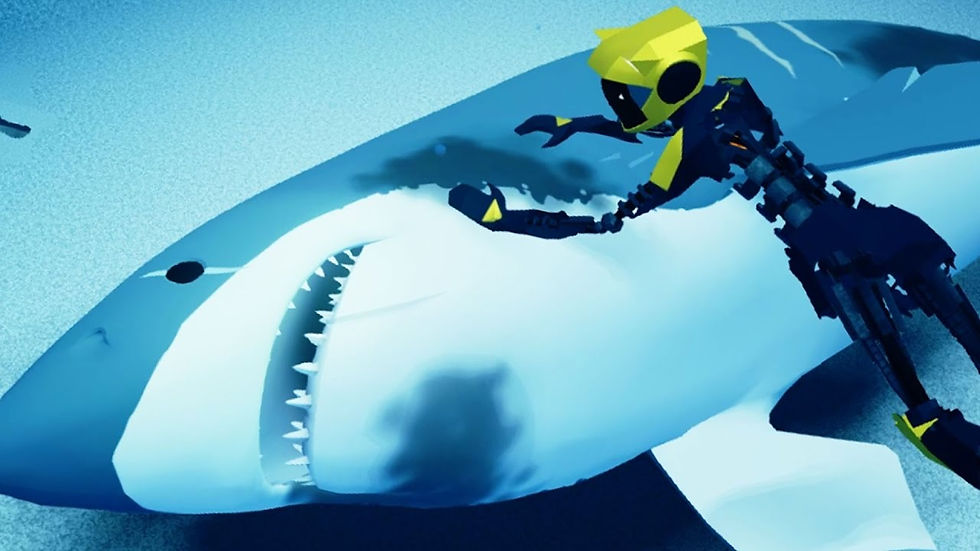
It's interesting, of course, that the only time we truly see death and it is treated as such is at the hands of IP. Animals eat each other frequently if you watch, and yet this never feels like death. It reminds me of the opening act of The Lion King, to be honest. The circle of life, for all the death it holds, is treated as honorable. There's no tragedy felt in one animal eating another in the wild in these stories, it's simply the way it is.
The other point of similarity in these stories is that, in both cases, there's no honor in murder. The shark's death reminds me of Mufasa's in that they both feel in direct violation of the circle that life naturally takes. Now, I'm not one to say that just because something is "natural" that means it's good. There are plenty of things in the world that are natural and yet we are either hurt by or choose not to partake in because they are just not good. And yet, in both cases, these deaths feel uniquely cold-hearted and tragic.

Death aside, you pick up and keep moving forward. You explore more of the remnants of the human world (did I mention this game is beautiful?) and eventually find yourself in the same hall you've been astral projection flying through in the monuments this whole game (ABZÛ is, again, very strange at times.) Nature then bestows upon the protagonist all of it's power, and brings back a ghostly visage of our shark friend, leaving one simple task for us: defeat IP once and for all.

The ending of the game is triumphant internally, although relatively quiet and subdued in reality. The big IP death star thing isn't destroyed in a massive explosion and buried at the bottom of the ocean, but rather allowed to return to nature, becoming quickly overgrown and restoring the natural order to the ocean around it. With it, the scars of human destruction are left to finally, truly heal. The game closes on an ocean cave teeming with ocean life, with the shark you befriended and you being the only traces of your (as well as humanity's) influence left as the credits roll.
There's a lot more that could be said about ABZÛ, to be sure. I can tell there's likely a lot more to the lore than I'm picking up on, and that's not to mention the impeccable attention to detail this game holds coming from such a small studio. Every species of fish is one in the real world, and they're portrayed as extremely alive. It truly feels like exploring the real ocean in terms of life. But as much as there's more to be said, this is long enough already, and I'm sure you have other stuff to do, so that'll be about it from me today.

I'm shocked more people don't point to ABZÛ alongside games like Shadow of the Colossus as a true example of video games as art. The entire game feels like an interactive piece of art that could be hung in a museum. If you haven't played it, well, I don't know why you're reading this, but I implore you, please do. It's honestly a masterpiece.
If you liked this post and would like to see more things written by me in the future, first off, let me know! It's extremely encouraging to get positive feedback, and it lets me know you're interested in stuff like this. Also, if you're so inclined, subscribe to my blog! I have a mailing list, so you'll be sure to know whenever something new comes up, whether it be a deep (hehe) analysis like this or something more light in tone. Thank you for reading, and until next time, get out there and play some games!

Comments